
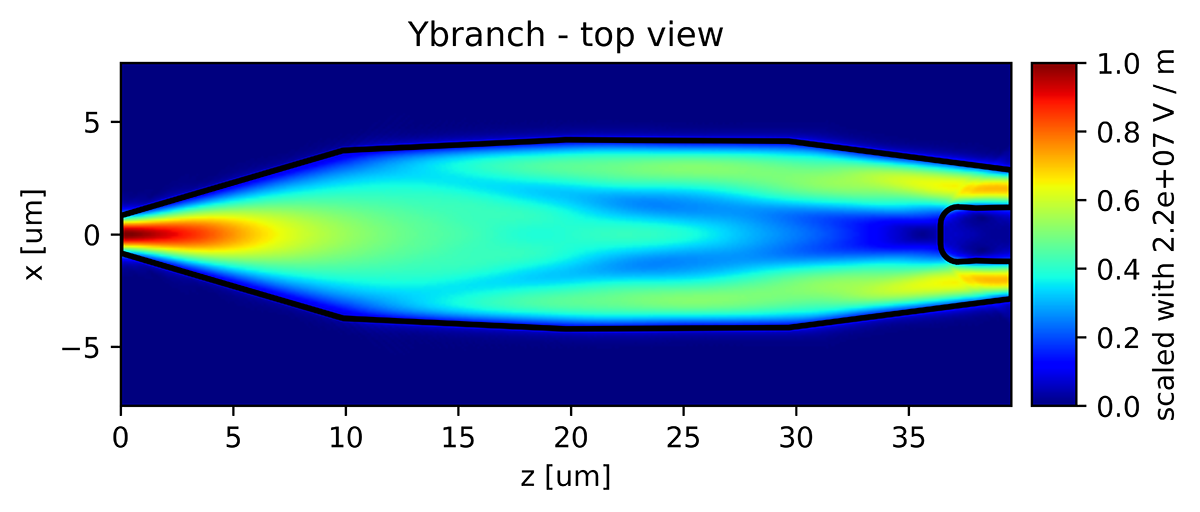
The beam propagation method is ideally suited for long slowly varying photonic devices such as this Y-splitter. With VPIdeviceDesigner, you can calculate the fields, optimize the transmission, and export the device S-matrix to integrate the optimized design into a photonic circuit simulation.
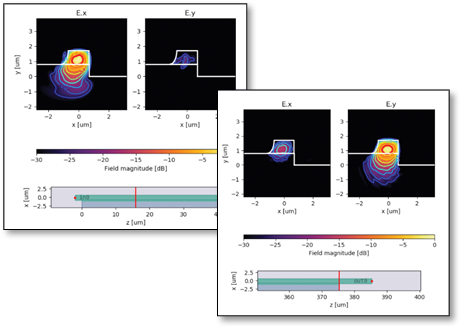
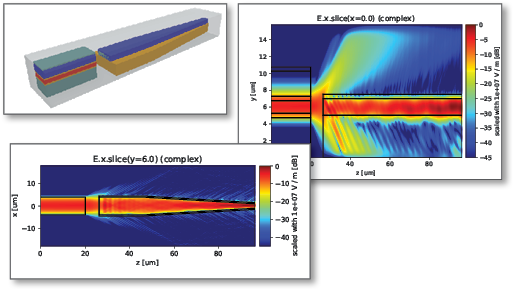
The shown indium phosphite-based waveguide utilizes its asymmetry to rotate an incident x-polarized mode field into a y-polarized field. In VPIdeviceDesigner, this device can be analyzed and optimized by combining mode solver results with either BPM or EME.
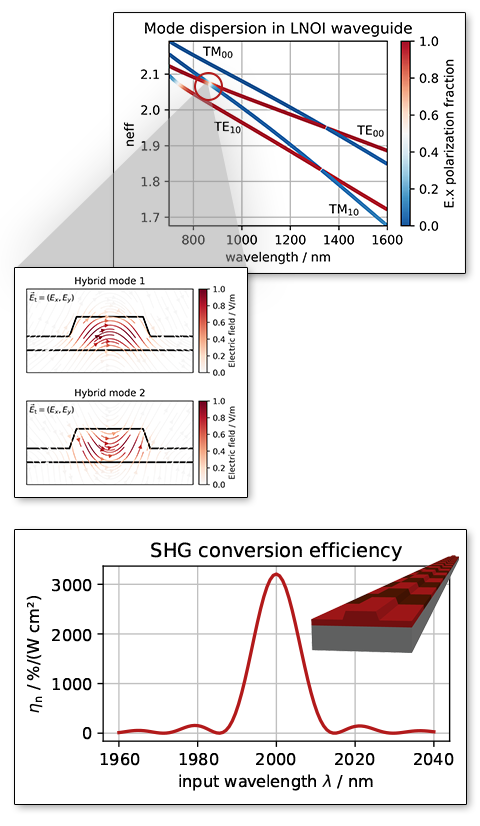
With VPIdeviceDesigner you can perform arbitrarily complex analysis of the properties of waveguides and fibers. Built-in calculation of effective and group mode indices, mode polarization fractions, and other characteristics allow, e.g., to analyze mode hybridization and avoided mode crossings in an anisotropic LiNbO3 waveguide. Advanced post-processing capabilities enable, e.g., the calculation of second-harmonic generation efficiency, poling period, and bandwidth characteristics of PPLN waveguides.
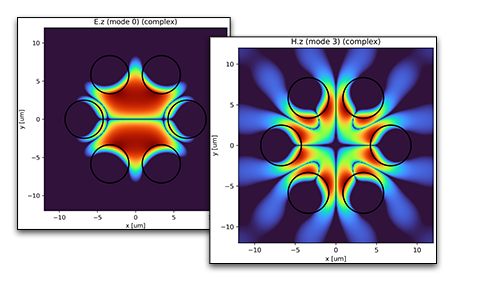
With VPIdeviceDesigner, you can analyze the properties of arbitrarily shaped fiber cross-sections, here for example a six-air-hole microstructured optical fiber that uses the locally reduced average refractive index of the air holes to guide the light. Built-in utilities allow for easy calculation of the effective mode area, mode confinement factor, effective and group mode index, attenuation, and other characteristics.
When different semiconductor technologies are combined, light needs to be coupled from one chip to another. In this example, a quantum-cascade laser and a germanium-based waveguide are coupled, followed by a taper to ensure single-mode operation. With VPIdeviceDesigner, you can optimize the input waveguide cross-section and investigate the influence of the air gap between the chips on the transmission.
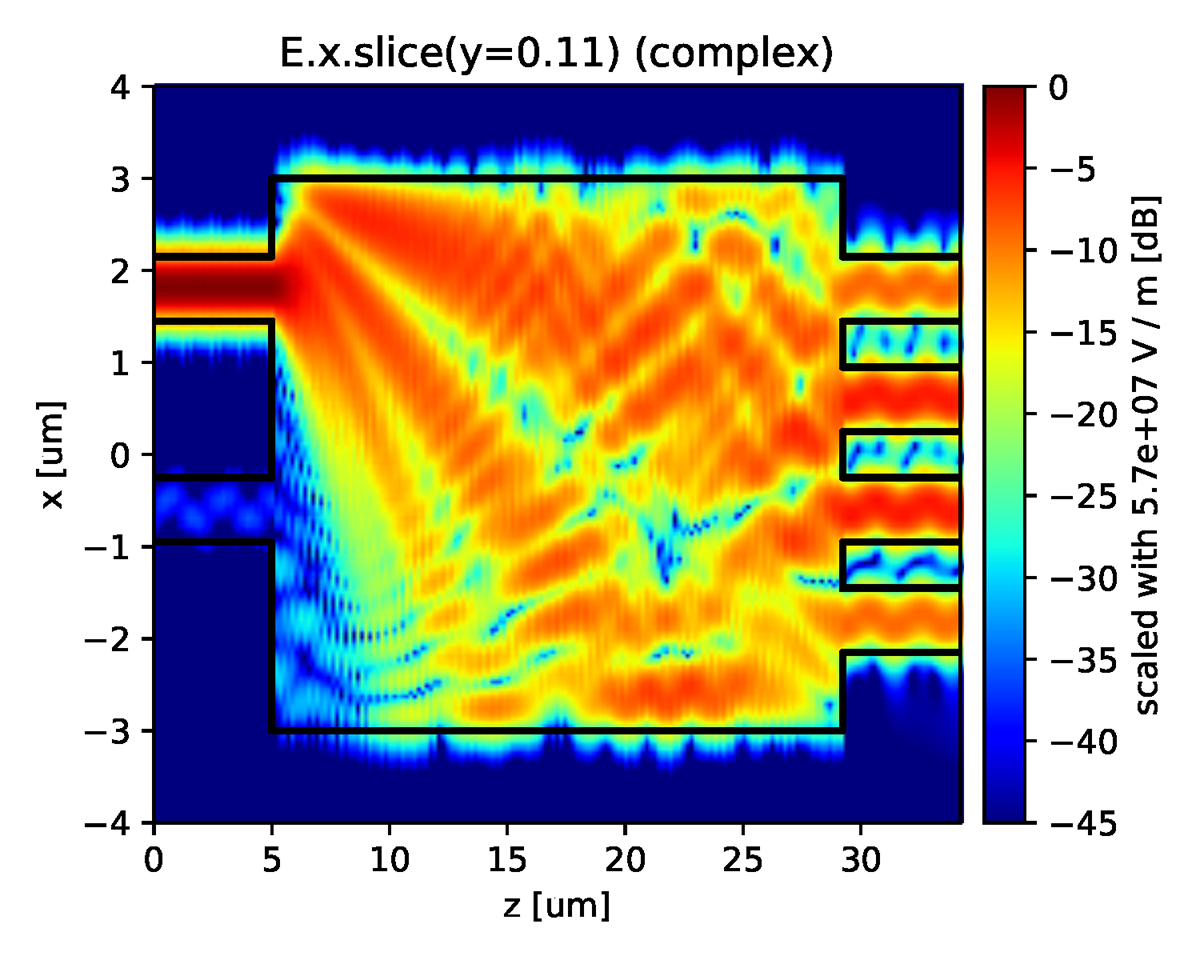
Multi-mode interference (MMI) devices can be efficiently optimized for the required S-matrix properties by using the EME solver. This example shows a 2x4 MMI optimized to work as an optical 90° hybrid coupler.
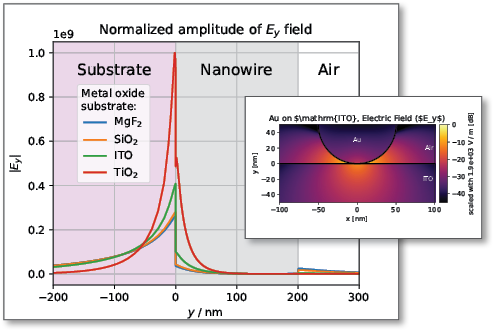
VPIdeviceDesigner's full-vectorial mode solvers accurately calculate not only modes in dielectric waveguides but also plasmonic modes with strong field confinement. The example shows a plasmonic mode's field distribution for an Au nanowire on an ITO substrate and the field enhancement for different metal oxide substrates.
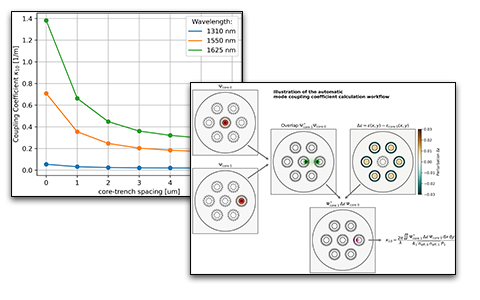
Trench-assisted multicore fibers are multicore fibers in which each core is surrounded by a lower refractive index ring (the trench). It improves the mode confinement, and reduces inter-core coupling and bending losses. With VPIdeviceDesigner, you can calculate the coupling coefficients and bending loss, perform parameter sweeps, and optimize the trench parameters to obtain the best fiber design.
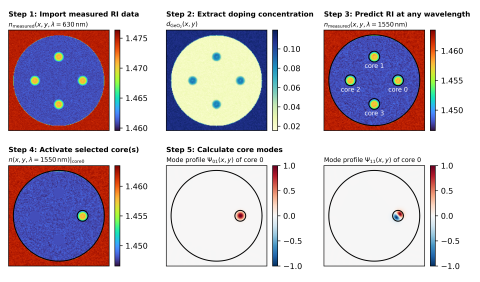
To calibrate simulation against measurements, it is important to be able to simulate exactly the fabricated fiber cross-section. However, measured refractive index profiles can often be obtained only for selected wavelengths, for example 630 nm. Based on a known dopant material, VPIdeviceDesigner can automatically extract the doping profile of the fiber and, based on known dopant material properties, predict the refractive index profile for any wavelength, for example to perform a broadband analysis around 1550 nm.