
Products

VPIlinkConfigurator™

VPIlinkConfigurator™ enables the rapid design of optical transport networks through the use of automated placement and provisioning of equipment as well as a thorough analysis of every aspect of link performance.

 
Graphical User Interface

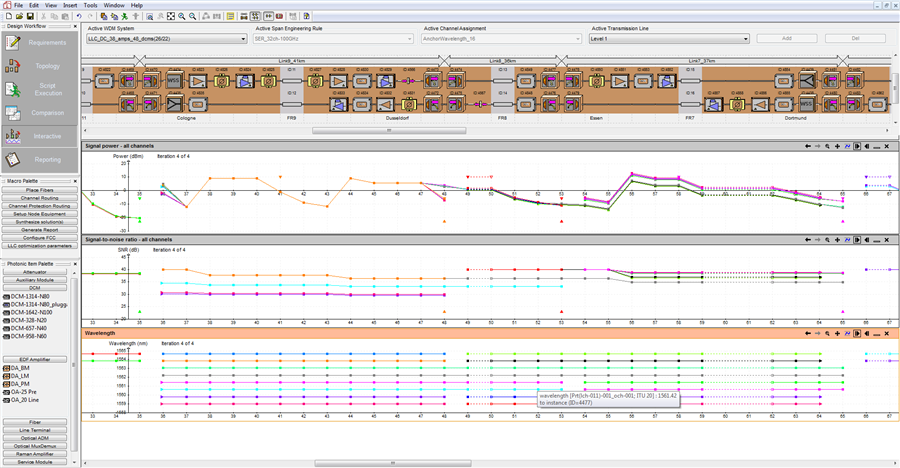
VPIlinkConfigurator provides a simple interface for component placement and performance analysis with maps displaying many different parameters including optical power, OSNR, dispersion and nonlinear distortion levels for XPM and SPM.

The combination of an intuitive graphical presentation and a powerful scripting interface make this platform a fully customizable automated link design and analysis tool. All aspects of the design process including the equipment libraries and characteristics and all link engineering rules and methodologies are controlled thus making optical network designs uniform across an organization. Using VPIlinkConfigurator enables rapid response to RFP′s without the mobilization of the entire engineering team.

Network topologies such as linear links, hubbed-rings and branched-networks are supported natively. More complex topologies such as ring and mesh can be handled with simple scripting.

 
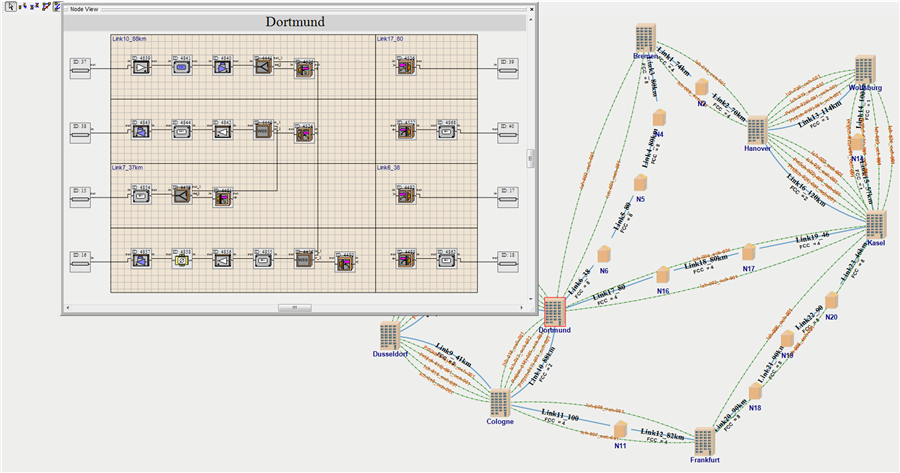
Branched Network Topology

The Graphical View in VPIlinkConfigurator provides a convenient interface for creating or
editing the model of the topology or traffic demands even in complex branched networks.

In the latest version of VPIlinkConfigurator, the user may explore the system on a node-by-node basis. Using this feature, higher degree nodes or nodes containing banded structures may easily be visualized and manipulated.

 
Single Node View

The Single Node View allows the user to visualize the arrangement of equipment within a node. Shown here are a degree three node on the right and a node constructed using a 4-band approach.

A powerful API enables interfacing with third party software such as common office applications and databases in addition to custom applications. Using this automation approach, network topologies, channel plans etc. can be extracted from other applications. Similarly, the results of the design, including equipment configuration and detailed performance, can be supplied to other applications to generate BOMs and any other report.

 
Customization using powerful API

Information can be exchanged with 3rd party applications through the use of VPIlinkConfigurator′s powerful API. This enables the development of very sophisticated design automation, reporting and analysis tools using applications such as MS Office.

Applications

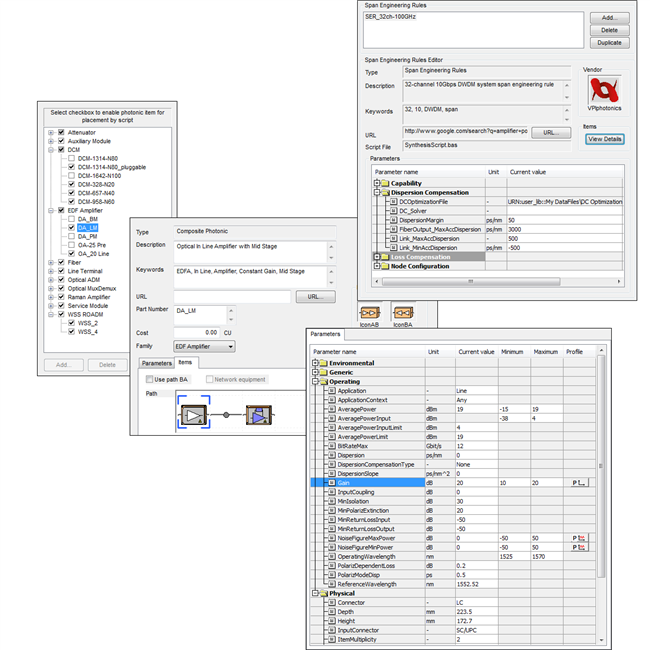
  • Define libraries representing characteristics of equipment families based on generic templates for all common component types.
  • Configure systems by optimizing node and hut locations, fiber types and equipment.
  • Design green/brown fields for branched networks, linear-ADM/OADM, and hub-rings.
  • Support cascadable OADMs and port-based receivers
  • Synthesize alternative solutions using real terminal equipment and vendor components.
  • Predict limitations on systems performance including optical amplifier characteristics, dispersion, crosstalk, PMD, nonlinearities and interchannel power transfer.
  • Formulate and test design strategies to account for component interworking restrictions, proprietary design techniques and configuration rules.
  • Chart signal power, noise and degradations along the link with uncertainty and min/max limits.
  • Reconfigure designs and adjust parameters manually, investigate automatically updated charts.
  • Generate Bill of Materials and performance reports in customizable format
  • and many more. (Explore application examples in detail!)


This is a print version of the VPIphotonics web page located at .