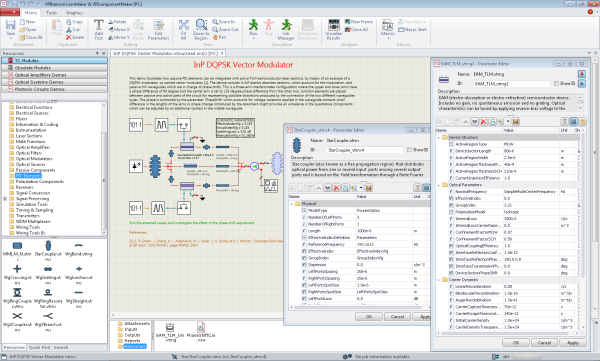

VPIcomponentMaker™ Photonic Circuits is developed with the goal to enable convenient, accurate and fast EDA-style design flow for elaborating modern and next generation photonic integrated circuits (PICs).
Such PICs are large-scale and heterogeneous, consisting of hundreds (many thousands in a few years) of passive photonic, active optoelectronic, and electronic elements. For their modeling, VPIcomponentMaker Photonic Circuits supports scalable heterogeneous circuit-level simulation framework: time- and frequency-domain simulation domains are seamlessly merged and can, therefore, be combined within the same modeled circuit.
In particular, all passive subcircuits are numerically accurately modeled in frequency domain employing the cascaded scattering matrix (S-matrix) approach, while time-domain simulations are used for only modeling interfaces between passive subcircuits and active devices.
This approach greatly reduces the overall simulation inaccuracies inherent to any time-domain simulations, and thus enables fast and accurate simulations of large-scale photonic integrated circuits with thousands of dispersive components (in contrast to purely time-domain approaches which allow simulations of photonic circuits with only a few tens of nonidealized components).
This approach also enables modeling multiscale integrated circuits with lengths of photonic components ranging from a few microns to several centimeters on the same chip. Importantly, our time-domain implementation of bidirectional connections between passive subcircuits and active devices does not introduce (if properly used) single-time-step numerical delays.
In native time-domain implementations, such delays are often responsible for inaccuracies in resonance or lasing frequencies, forcing designers to perform simulations with unreasonably small time steps just to mitigate such problems.
The cutting edge simulation framework of VPIcomponentMaker Photonic Circuits is complemented by extensive libraries of standard passive photonic and optoelectronic devices, electrical and digital logic elements, and hundreds of instrumentation utilities and signal processing tools. Any missing device can be added using cosimulation with Python, Matlab®, C++, or COM interface, and, importantly, such user-defined devices will be fully integrated into the simulation framework.
Our hierarchical design approach allows creating compound devices (subcircuits) which can be used in the same way as native and cosimulated devices. The support of parameter expressions and advanced scripting capabilities allows you to set up compound devices with a complex logic inside, as well as to perform advanced design optimization and yield excellent analysis results. Basic parameter optimization and yield estimation, multidimensional parameter sweeps, and interactive parameter tuning are conveniently supported at the GUI level.